

Jew Street Mattanchery
Tuesday, 31 March 2020
1) JEWISH BUNGALOW IN VETTACKAL, ALAPUZHA (CURRENT PRIMARY HEALTH CENTRE OF VETTACKAL)

Saturday, 28 March 2020
2) KODER HOUSE OF FORT KOCHI

Unlike many hearsay statements floating around in online sites, the Koder house was not built in 1808 by Jewish merchant Samuel S. Koder, the patriarch of the prominent Koder family. As a matter of fact, he was not even born at that time! However, it is true that Samuel S. Koder (1864/68-1941), the father of S. S. Koder, bought the house from a non-Jewish owner or organization in 1905 and significantly remodelled the structure into the current form. In the opinion of Queenie Hallegua, the daughter of S. S. Koder, the house was bought from a Portuguese owner by her grandfather (Samuel Koder) between 1910-1915, and it was demolished to build the Koder House by a gentleman named Cohen. Anyway, it is generally assumed that the building was originally constructed as a Portuguese style mansion in the 1800s. There is also saying that Samuel Koder constructed the house across three floors-one for each of his sons (Elias, Shabdai (S.S. Koder) and Cecil), and the Portuguese style building was structured and gabled in Europe, and then shipped to Cochin. In Jewish hands, Koder house hosted many prominent dignitaries including ambassadors and celebrities or heads of state. Their Friday night "open house" dinners were very popular when the Koders were around, for more details see this interesting article. The lower floor of the house functioned as a departmental store for some time, the Koders had multiple such stores in different parts of Kerala. The Koder House was later sold to a non-Jewish buyer by Queenie Koder, ending a long chapter and a century-old Jewish connection to the building. Nevertheless, the new owners are careful in preserving the Jewish heritage and traditions of the site. Since 2006, every December, the Koder House celebrates Hanukkah, the 8-day Jewish festival of lights by lighting the traditional menorah (lamp). Photographs and portraits of S. S. Koder are well preserved and kept on the ground floor.
Friday, 27 March 2020
3) LILY KODER HOUSE & THE HANGING BRIDGE OF FORT KOCHI

Photo: November, 2019
Another Jewish mansion, formerly owned by the Koders is the current luxury hotel Forte Kochi. Located on the popular Princess Street in the center of Fort Kochi, it was originally the house of Lily Koder, spinster and sister of S. S. Koder. Before the 'Paul John Resorts & Hotel Group' started Forte Kochi recently, it was a different heritage hotel by the name Spice Fort, maintained by the Dune Eco Group. The hotel offers 27 luxury colonial-style rooms and assures all the modern luxury amenities. Their official website says, "Originally built by the Portuguese, the mansion presents a medley of Portuguese, Dutch and British influences and was converted to a magnificent home in the late 1800s. This ancient structure was once part of the palatial home of an eminent Jew family". More reliable accounts estimate that the Jewish ownership and recasting of the building occurred only in the early 1900s. Wednesday, 25 March 2020
4) DAVID HALL OF FORT KOCHI

Tuesday, 24 March 2020
5) 'SHADY VILLA' or 'KODER VILLA' of ALUVA

Monday, 23 March 2020
6) KRATHI VEEDU OR HALLEGUA HOUSE OF MATTANCHERRY

Photo: September, 2019
Anyone who has been to the Paradesi Synagogue will pass in front of this 18th century traditional Jewish house with yellow walls, grey windows and a tall door. The vintage home built in the Dutch architectural style with a steep gabled clay tile roof has the date “1761” inscribed on the top of the front door. The house, opposite to the Post Office building, sits on a T-junction in the Jew Town of Mattancherry which splits off to the right (north) to Paradesi synagogue; to the left (south) to the Kadavumbhagom Synagogue and Kochangady region; and to the east to Mattancherry Boat Jetty area. In fact, the famous ‘Synagogue Lane’ of Mattancherry starts from this particular Jewish house and extends till the Paradesi Synagogue. The home belonged to Joseph E. Hallegua (1922-2012) who was fondly called “Johnny” by his community. His wife Juliette and daughter Yael were the last Jewish residents of “Hallegua House” and as far as I understand they have migrated to Israel on 2019 and the house was sold to a non-Jewish buyer. An article that has appeared in the Hindu Newspaper (April, 2019) has more details and photographs here. According to the column, the house is known as “Krathi Veedu”, the Halleguas hosted parties for Jewish festivals such as Succoth (Feast of Tabernacles) and Simchat Torah (rejoicing of/with Torah scrolls) from here. Also, every Paradesi Bridegroom left for their wedding from the Hallegua House. It is said that Krathi Veedu will be converted into a museum, so let’s hope we will hear more about that in near future.Saturday, 21 March 2020
CHAKKAMPARAMBU-A JEWISH CEMETERY IN KODUNGALLUR?
In February, 2017, my search for the Joothakkulam (Jew Pond) ended at Kunnamkulam in the west Methala region of Kodungallur. Joothakkulam is the sole relic left from the lost Jewish settlement of Kodungallur (Crangannore), the legendary site of Shingly which supposedly became extinct in 16th century AD. There is also a Joothakunnu (Jew Hill) associated with the Joothakkulam, but the hill has been flattened out and do not exist anymore. I have discussed in detail about Shingly and its Jewish significance here. Not everyone agrees with a Jewish Kingdom in Shingly and they consider its antiquity from first century as a myth invented by the Paradesi Jews to promote their superiority over the Malabari Jews, but I don't think even the strongest critic would have serious objections in accepting the existence of a Jewish settlement at Kodungallur during the Middle Ages. The existence of a still surviving pond named after Jews in Kodungallur or the ritual of using soil from the region for Jewish funeral rites could be an indication that there are some shreds of truth in these legends.
Wednesday, 18 March 2020
MALA -A MODEL TOWN FOR RELIGIOUS HARMONY
So far we discussed about the Jewish monuments of Mala and their current status. However, Mala is not just about its Jewish heritage alone, the multi-religious culture and scenic beauty of the region are admirable. In a radius of one km, Mala has a synagogue (Jewish), a church (Christian), a temple (Hindu) and a mosque (Muslim), a unique feature very few sites in the world can boast about. In this context, a special mention should be made to the village of Chendamangalam in Kerala where also worshiping centers of Judaism, Christianity, Islam and Hinduism exist within a short distance of each other. The major religious structures in Mala town are the Synagogue at the center, St. Stanislaus Forane Church at the north, Muhiyudheen Juma Masjid at the south and Mukunda Krishna Swamy Temple at the north-east directions. Suppose you measure the walking distance from Mala synagogue to these monuments using Google Map, the Masjid comes the nearest (180m) followed by the Church (350m) and the Temple (650m). Surprisingly, the distances are also identical in Chendamangalam when the Synagogue is used a central point to measure the distance to Juma Masjid-Kottayil Kovilakom (200m), Holy Cross Syro Malabar Catholic Church (350m) and Sree Krishna Swamy Hindu Temple (600m), but the settlements are older than Mala. The close coexistence of Mala`s religious centers is an ideal example of the multicultural harmony of the town. Historically, the gateway to Mala was through Malakadavu, the ferry slip which connected the town to the backwater system of Kerala and through that to the prominent trade centers. The following map will give you a better idea of the location of these sites in Mala.
Wednesday, 11 March 2020
THE LOST TOMBS OF MALA JEWISH CEMETERY
Traditionally, Mala had a Jewish population from the late 10th century onwards, but the first documented evidence to support a Jewish presence in the town is only from 1786 in the Hebrew letter of Ezekiel Rahabi, who estimates 50 families and one synagogue in the area. At the time of aliyah to Israel in 1950s, Mala's Jewish population was at the peak and the highest estimate puts their numbers to 300 distributed in about 50 families. Let us suppose that Mala had a Jewish presence from 18th century only, and even if we take into account of their minuscule number during late 18th to mid 19th century, there should still be around a thousand Jews who lived, died and were buried on the grounds of Mala cemetery. The irony being that, despite having the largest Jewish cemetery in India, the 4-acre Mala graveyard has only three tombs today! Where have all the graves gone? How many tombs were there at the time of transfer of the cemetery in 1955? I have come across various estimates, mostly online Malayalam articles and sites that have put forward their numbers from 20, 30, 34, 35, 40, 50 and 60. I don't know how these specific numbers are arrived, my own personal interactions with people in Mala who were old enough to remember the time of Jews, fail to recollect more than three tombs!

Photo 1) Mala Jewish Cemetery in 1968. Photo Courtesy: Rabbi Bernard W. Kimmel, published in the 1968 volume of 'B'nai B'rith Messenger'. The tomb positions are marked 1 and 2.
Tuesday, 3 March 2020
THE SURVIVING TOMBS OF MALA JEWISH CEMETERY


Photos: August, 2015
There are only three tombs left in Mala Jewish cemetery and they are located in the 1.5-acre western half of the cemetery (see map here. 1, 2 and 3 in the map are the position of the tombs). The tombs are relatively well preserved, but one of the epitaph is not legible. The largest tomb (1) which unfortunately has the indecipherable tombstone is positioned around the middle of the western section of the cemetery. The other two tombs are located near the partition wall segregating the western and eastern parts of the cemetery. The middle tomb (2) has the best preserved epitaph with nicely engraved Hebrew inscriptions on a good quality marble slab. The easternmost tomb (3) has a grave marker (probably in cement base) with legible Hebrew inscriptions but the craftsmanship is average when compared to the second tomb. I have included photographs from my earlier visits as well since some of the inscriptions are more clear in old photographs.
Sunday, 23 February 2020
JEWISH CEMETERY OF MALA-A TIMELINE OF EVENTS SINCE 1955.
I will be brief here and include only the important events and decisions associated with cemetery. Not all dates are accurate to my knowledge, so I would be happy to incorporate corrections as required and add if there is any relevant information that I have failed to mention.
1954, December 20: A contract was executed by (1) Avarony Jew aged 77, son of Mosha of Vadama Village, Mukundapuram Taluk, (2) Pallivathukkal Eliacha Jew aged 75 Son of Kunjeli of Vadama Village Mukundapuram Taluk, (3) Chennamangalathukaran Eliabai Jew aged 50, Merchant Son of Aphraim of Vadama Village Mukundapuram Taluk-Trustees of the Mala Synagogue on behalf of the Synagogue (referred to as Donors) in favour of Athappilly Joseph Christan aged 37 Son of Devassy, Vadama Village, Mukundapuram Taluk the President of the Mala Panchayath for and on behalf of the said Panchayath (refererred to as Donee). The contract was the entrustment of all properties movable and immovable appertaining to the Jewish synagogue including the synagogue building and its premises (23 cents, valued Rs. 500) and the Jewish cemetery (400 cents, valued Rs. 500) as a deed of gift to the Panchayath, provided it was subjected to the conditions and obligations recited in the contract. There were six conditions to be fulfilled namely:
1954, December 20: A contract was executed by (1) Avarony Jew aged 77, son of Mosha of Vadama Village, Mukundapuram Taluk, (2) Pallivathukkal Eliacha Jew aged 75 Son of Kunjeli of Vadama Village Mukundapuram Taluk, (3) Chennamangalathukaran Eliabai Jew aged 50, Merchant Son of Aphraim of Vadama Village Mukundapuram Taluk-Trustees of the Mala Synagogue on behalf of the Synagogue (referred to as Donors) in favour of Athappilly Joseph Christan aged 37 Son of Devassy, Vadama Village, Mukundapuram Taluk the President of the Mala Panchayath for and on behalf of the said Panchayath (refererred to as Donee). The contract was the entrustment of all properties movable and immovable appertaining to the Jewish synagogue including the synagogue building and its premises (23 cents, valued Rs. 500) and the Jewish cemetery (400 cents, valued Rs. 500) as a deed of gift to the Panchayath, provided it was subjected to the conditions and obligations recited in the contract. There were six conditions to be fulfilled namely:
Wednesday, 19 February 2020
THE CURRENT STATUS OF MALA JEWISH CEMETERY
One can say without doubt, that the most controversial Jewish monument in Kerala is the Mala Jewish cemetery. The cemetery was handed over to the Panchayath (the Village Council) by the Jewish community in 1955 with the following conditions: "The Donee shall maintain at his own expense the Jewish Cemetery described in the B Schedule hereto annexed and hereby entrusted to his possession and shall preserve the same without trespass or molestation of the tombs. Nor any portion of the Cemetery be dug or unearthed. The compound wall bounding the cemetery on all sides and the gate in it shall also be preserved and the Donee shall meet the expenses, if any, necessary for the preservation in good repair. The B Schedule item shall not be alienated and shall ever be preserved in its present condition without being put to any other use: nor shall the right of any member of the Jewish Community to use the B Schedule item as Cemetery ever denied or questioned"
Tuesday, 18 February 2020
THE JEW STREET OF MALA
In Mala, if you walk half kilometre from St. Stanislaus Forane Church to Mohiyuddien Juma Masjid (north to south) and the same distance from the Synagogue to the Jewish Cemetery (west to east), you have essentially seen the whole town! The intersection of these streets where the north-south Kodungallur-Kodakara (State Highway 51) and the east-west Mala-Annamanada roads meet is the Mala Junction, the epicentre of the town. The Jew Street of Mala (marked by the yellow dotted lines in the map below) is a small stretch of about 200m of the Mala-Annamanada road beginning from the Synagogue (1) at Mala Junction (2), passing through the modern Post Office building (3), and extending almost up to the junction near the current Mala Private Bus Stand where the K Karunakaran street joins the main road (see Map). The Jewish Cemetery (4) is only 300 m further east to the Mala Private Bus Station. Most of Mala Jews were small vendors who maintained their shops in front of the house facing the Jew Street and their living quarters were at the backside of the building.
Friday, 14 February 2020
THE JEWISH POPULATION OF MALA
Scholars do not reach a consensus on the date of Mala Synagogue's foundation. The earliest date attributed to the synagogue is 1000 AD, based on its association with Joseph Rabban (of the 11th-century Copper Plate fame), who according to an old Jewish folk song, obtained wood from the Rajah of Kodungallur to construct the building. Dravidian Judaist, Prem Doss Swami Doss Yehudi (1990) claims "The original Synagogue (11th century) was pulled down and a new building was erected in 1400 C. E. A Hebrew congregational school also used to function there. It was renovated in 1792 C. E." Yehudi however, does not cite the source on which he bases such an absolute date, some connects it to the great Periyar flood of 1341 which erased the port city of Muziris and may have led Jews to migrate from Kodungallur to Mala. The renovation date two years after Tipu Sultan's invasion (1792) makes sense, but historically we know that the synagogue was in a badly decayed state even three decades after Tipu's attack. David Sassoon (1932) dates the synagogue to a later period, to 1597, but he also fails to provide the evidence for arriving at such a specific date, probably the Portuguese attack on Kodungallur was responsible for a wave of migration of Jews to Mala by the end of 16th century. The earliest documented evidence for a Jewish community in Mala is in the 1768 Hebrew letter of Ezekiel Rahabi, where he mentions 50 Jewish families and one synagogue. Later, his son David Rahabi (d.1791) also attests the same statistics. It is surprising that Mosseh de Paiva (1687) who records 9 Malabari synagogues from 6 localities in Kerala fails to mention a congregation in Mala, so do the Dutch Governor Adrian Moens who wrote less than two decades after Rahabi in 1781. Interestingly, though Moens states that Malabari Jews were spread over seven places, he lists only six, and for reasons unknown Mala is excluded. Nevertheless, in the same year (1781), we have a Hebrew manuscript entitled "Toldot Yehude Kuchin" by Saraf, Yahya Ben Abraham, where Mala reappears with one synagogue and 50 families. A few years later in another Hebrew letter dated 1790, by Samuel Abraham to a Jewish merchant in New York, the numbers remain firm at 50 families and 1 synagogue.
Tuesday, 11 February 2020
STRUCTURAL ALTERATIONS IN THE PREMISES OF MALA SYNAGOGUE SINCE 1955
Earlier we discussed about the structural modifications done in the Mala Synagogue; in this post we will see the alterations carried out at the premises of the sanctuary. We learn from the Mala Contract (1955) that the synagogue had boundary walls on three sides and was bordered by privately owned (non-Jewish) buildings and compounds at East, South and West directions, and a Panchayath Road (CMS Road) running on the North side. Originally, the synagogue compound measured 32 cents (1294 sq m), but 9 cents (364 sq m) of land on the East side was sold already at the time of transfer (1955). After Jews left Mala, the synagogue was used for conducting classes for Lower Primary students and it also functioned as a Community Hall. The surroundings of the synagogue were heavily altered and a big share of land was misused. To get a better idea, one might look for old photographs taken from the premises. This is where the photographs taken in 1995 from Mala by the Center for Jewish Art (Hebrew University of Jerusalem) under the Bezalel Narkiss Index of Jewish Art (http://cja.huji.ac.il) become much helpful. Despite taken relatively recently (40 years after Jews left Mala), these photos reveal how significantly the synagogue premises have changed within such a short span of time. We will compare some of these photographs with the latest images and see the depth of encroachment.
Thursday, 23 January 2020
MALAYALAM-HEBREW INSCRIPTIONS IN THE UPPER GALLERY OF MALA SYNAGOGUE
The Bilingual Inscriptions of Mala Synagogue
A casual visitor to Mala Synagogue need not necessarily identify the structure as a Jewish worship centre unless the inscriptions on the balcony are noticed. The writings in Hebrew and Malayalam do not convey the same message, but both agree on the date of establishment of the synagogue. The lengthy Malayalam inscription gives additional details about the predecessor synagogue(s), while the Hebrew line quotes a verse from the Bible. The only other Hebrew inscription was on the door lintel of the Breezeway, which unfortunately is lost over a demolition drive that took place on 2017 (see my previous post for more details).

Sunday, 12 January 2020
STRUCTURAL ALTERATIONS ON MALA SYNAGOGUE SINCE 1955

Typical to other Kerala Synagogues, Mala's Jewish worship centre also consisted of a two-story gatehouse, a two-level breezeway, and a double-height main sanctuary with an upper gallery and second Tebah. The upper floor of the gabled gatehouse functioned as a Hebrew School which also had an attic that was used as a store room. The second level of the breezeway was covered yet not fully enclosed and the ground level was open and likely supported by columns. The main entrances to the synagogue was at the eastern end through the lower level breezeway leading to the Azara and the upper passageway opening to the women's seating area behind the balcony. Time unknown, but probably soon after Mala Jews left in 1955, additional structures were added in front of the gatehouse. Similarly, the open section of the breezeway at the ground level was enclosed and filled in with concrete to make way for commercial buildings. The connections from breezeway to the original entrances of the synagogue through Azara and women's room were cut off and a 5 foot gap blocked its continuity to the main sanctuary. Architect Jay Waronker (2010) finds Mala Synagogue’s breezeway a quintessential example of Kerala timber vernacular architecture with its beautifully ventilated and diffusely lit “walls” made of struts with a latticework of interlinking laths giving a Venetian blind effect. Today, the Synagogue is surrounded by private commercial buildings (South and West) and public roads (East and North). The freestanding boundary wall in the southern border perhaps could be the original construction from pre-mid-20th century, but the current wall on the west is a later addition only. We know from the 1955 Mala contract that the Synagogue was surrounded by "compound wall on three sides". The current wall on the north is a modern construction built after demolishing an illegal commercial complex that existed on the spot.
Monday, 2 December 2019
THE 26 ELEGANTLY WOOD CARVED LOTUS FLOWERS BENEATH THE UPPER GALLERY OF MALA SYNAGOGUE.

The abundance of wood used in Mala Synagogue
Before coming to the details, a brief background of the current state of Mala's Jewish monuments. Mala has the northernmost synagogue in Kerala and it is also one of least explored Jewish monuments. After Mala's Jews decided to leave for Israel, their synagogue and cemetery were donated freely to the Grama Panchayath (Village Council) of Mala on December 20, 1954 under the main conditions that 1) the synagogue would not be converted to a place of Worship of any denomination or used as a slaughter house and the Panchayath would do all the annual maintenance and repair at their own expense; 2) the cemetery shall be preserved with a compound wall on all sides and a gate, and no part of the cemetery would be dug or unearthed. The contract was registered on January 4, 1955.
Saturday, 30 November 2019
RARE PHOTOGRAPHS OF THE OLD THEKKUMBHAGOM SYNAGOGUE OF ERNAKULAM BEFORE IT WAS DEMOLISHED IN LATE 1930S

A synagogue from Ernakulam in the background (September, 1937). Magnes Collection: [76.311.2.1 (CJ 10)]
Another gem from David G. Mandelbaum, and this slide from 1937 has the image of an unknown synagogue in the background. The title reads, "Ernakulam. Jewish girl holding her brother who wears only skull cap and abdominal band. Synagogue in background." At first glance, I thought it was the Paradesi synagogue, because of the well (1) in the courtyard and the upper passageway (2), but on a closer look I realized the structure is different. For instance, the front windows (3) are plain and simple compared to the ones in the Paradesi synagogue. In fact, Mandelbaum has even a photograph of the Paradesi synagogue taken in 1937 from the same angle (see here), and you can notice the style of windows is different. The title of the slide gives the place Ernakulam, and unlike western travellers who sometimes interchange the names Ernakulam and Cochin, Mandelbaum was aware of the difference and he used Cochin specifically for Mattancherry, therefore, it has to be one of the two synagogues in Ernakulam.
Wednesday, 13 November 2019
INTERIOR OF THE THEKKUMBHAGOM SYNAGOGUE OF MATTANCHERRY
In the previous post, I discussed about the exterior of the
Thekkumbagom synagogue. As for the
interior, we should look for someone who visited the synagogue before the
mid-1960s and took a photograph inside. There is of course, the possibility of finding photographs from the personal collection of the
Jewish community, but their accessibility would be even more difficult. Luckily, we
have some of the important religious articles inside the synagogue photographed
and saved before the sanctuary was dismantled. For instance, the Holy Ark
(Heichal) of the synagogue is currently preserved in the Magnes Collection
of Jewish Art and Life (former Judah L. Magnes Museum) in Berkeley, California in
USA (see here for Magnes Museum’s photograph and here for my previous post). In this upload, I wish to share a few pictures
that can shed light on the interior of the synagogue.
Friday, 1 November 2019
TWO RARE PICTURES OF THE EXTINCT THEKKUMBHAGOM SYNAGOGUE OF MATTANCHERRY (EXTERIOR)

Site of the former Thekkumbhagom Synagogue (January, 2011)
Until the mid-20th century, there were 8 synagogues in Kerala. Today, only 6 remain intact, two of the synagogues in Mattancherry-the Kadavumbhagom is in ruins and the Thekkumbhagom is extinct. In fact, it was Thekkumbhagom of Mattancherry, the first synagogue to be demolished in Kerala, and in the place a two-storied modern building was erected (for more details see here and here). Not a trace of the synagogue is left on the site that can relate to its existence. I had always wondered how the synagogue looked like, but there was no way to know due to the scarcity of finding a photograph of the sanctuary before it was destroyed, and what is more ironic is that the building was standing at least until the mid 1960s! However, there was a remote possibility that the synagogue could be captured accidentally by visitors who took photographs of the Jew Street because of it's location very near the Paradesi synagogue. See my earlier post where I discussed about an old photograph in this context, unfortunately it was clicked one step short of the Thekkumbhagom synagogue (see here). To my greater satisfaction, I was proved right, the synagogue was photographed by a visitor more than 100 years ago, and in the process of depicting the 'Main Street' of Cochin's Jew Town for an article in a periodical, he captured the Thekkumbhagom synagogue unintentionally! After a decade, in another periodical, a picture of the Jew Street in the form of a graphical sketch appeared, and the synagogue was again included.
Thursday, 31 October 2019
A SHORT VISIT TO THE JEWISH SITES IN ERNAKULAM-KOCHI (30 OCTOBER 2019)
Old Jewish Cemetery of Ernakulam.
 The cemetery is back to its neglected state. Promises are promises!

Tuesday, 22 October 2019
RABBI NEHEMIAH BEN ABRAHAM MOTTA OR NAMIA MOTTA (d. 1615) AND HIS TOMB IN MATTANCHERRY (COCHIN)

Where can you find a Jewish tomb revered by Christians, Muslims and Hindus other than in India? In 2011, the first time when I saw a large tomb with conspicuous Hebrew inscriptions, I was actually shocked to find such a monument standing alone in a highly unexpected place- deep inside a very congested and dense non-Jewish residential colony. The tomb belongs to a 16th century Jewish mystic by the name 'Nehemiah ben Abraham Motta', locally known as 'Namia Motta'. Sometime after his death, legends and myths started to build around his name and he was eventually transformed into a miracle worker, a multi-religious saint and to some (non-Jews) even a village-deity.
Tuesday, 1 October 2019
REMAINS OF AN EXTINCT MALABARI JEWISH CEMETERY, MATTANCHERRY.
Most visitors to the
Jew Town of Mattancherry would notice the high walled Jewish Cemetery. However,
not many would realize that this cemetery is exclusively used by the Paradesi
Jewish community. There existed an older graveyard for the Malabari Jews, which according to some, were used by the Paradesis also.
The old Jewish cemetery was located south of the Paradesi cemetery,
and it served members of the Kadavumbhagom and Thekkumbhagom Malabari congregations. After the Malabari Jews left for Israel
(1950s onwards), the cemetery was abandoned and eventually demolished by the local
community for establishing a shanty colony. Today, the sole surviving
structure from the entire cemetery is the tomb of a well revered early 17th century
Jewish mystic named Nehemiah Motta (Namia Mootha). See my earlier visit to Motta's tomb here, and if you are interested in a more detailed description on the topic go through my next post here.
Monday, 30 September 2019
RENOVATION OF THE PARADESI JEWISH CEMETERY OF MATTANCHERRY (15 September 2019)

Saturday, 28 September 2019
REVISITING THE JEW TOWN, MATTANCHERRY (15 September 2019)
My last visit to the Jew Town was in March, 2017, so it was some time since I had been to this area. I see a few of the monuments have been beautified and will discuss more about them in future posts. A few snaps from the visit:

The Synagogue Lane
Thursday, 26 September 2019
THE JEW TOWN OF MATTANCHERRY-a walk through history.
Imagine you are in Jew Town of Mattancherry in the
early 20th century, and you start walking straight towards the south from the
Maharaja's Palace (the Dutch Palace)-by the time you cover a distance of 2 km
you will pass through 4 synagogues! (see Map below). The northernmost Paradesi Synagogue (1568)
followed by the Thekkumbhagom (1647), Kadavumbhagom (1544) and Kochangady
(1344) synagogues. The southernmost Kochangady Synagogue which is also the
oldest would be in ruins (supposedly demolished in the late18th century), but
it's remains would be still visible. You will find the remaining 3 synagogues
intact, active and vibrant with Jewish presence.


Major Jewish monuments in Mattancherry. Courtesy, Google Map
Wednesday, 25 September 2019
THE KADAVUMBHAGOM SYNAGOGUE OF MATTANCHERRY-A Vanishing Heritage
The structure of the synagogue:
For more details on the structure and history, see my earlier post (updated) here. The Kadavumbhagom Synagogue of Mattancherry shares similar architectural
features with other existing synagogues in Kerala. The synagogue is
aligned in the east to west direction. The complex
begins with a
double-storied gatehouse at the eastern end followed most probably by a breezeway to a
two-storied structure that opens into the main
sanctuary building at the western end. The two-storied structure had a
lower Azara or Anteroom, and an upper floor which is the women's seating
room. The anteroom is the buffer space of the synagogue, mainly used as
a waiting area and a place for storage. There was
also a Hebrew school in the synagogue and I believe it was adjacent to
the women's room or part of the upper floor of the gatehouse. Inside the
main
double-height long rectangular sanctuary building, was a central Tebah
(Pulpit) and a beautifully
carved wooden Heickal (Holy Ark), the holiest part of the synagogue where the Torah Scrolls were kept. The Ark was placed at the at the western wall facing Jerusalem. One of the prime attraction of the synagogue was the elegantly carved and painted ceiling woodwork. In
addition, there was another pulpit inside the sanctuary at the eastern
end. The second reading desk was part of the upper wooden balcony,
reached by a staircase from inside the synagogue. An extra pulpit is
unique to Kerala synagogues and was used on special occasions. The upper
balcony is separated from the
women's room by a latticework partition. Access to the women's gallery
was not inside the sanctuary but through a staircase from the
anteroom.
Tuesday, 24 September 2019
The Eastern (Front) Side of the Kadavumbhagom Synagogue Complex (Mattancherry)-transformation through ages.
The following photographs will give you an idea on how the front side of the synagogue had been altered with time. The first snap, a beautiful colour photograph taken in 1956 shows clearly the original synagogue before any structural damage has occurred. The photograph is of excellent quality, the colours are bright and vivid and more importantly, you can see details the double-storied gatehouse and the fully intact gable. Also do not miss the 1957 black & white photograph of the synagogue taken from the same angle here. Two decades later, you can see in the 1977-photograph by Barabara Johnson-the gatehouse has disappeared, but the main sanctuary building remain with all the four windows on the front wall intact. A
more careful analysis of the photograph would reveal some
interesting features like the steps to the synagogue (was intact in 2011), the two pillars in the
front, the small construction attached to the southern wall of the
sanctuary building and the border outlines on the gable-none of them remain today. For the source and other details regarding all the old photographs, see my earlier post here. In 2011, when I visited the synagogue for the first time, there was a metallic shutter door on the anteroom and all the windows on the front wall were sealed. The synagogue remained more or less the same except for the absence of a door in the anteroom as seen in the 2017 photograph which I took during my last visit before the collapse of the sanctuary.


The Front Side (East) of Kadavaumbhagom Synagogue of Mattancherry at different stages.
The Southern Courtyard of the Kadavumbhagom Synagogue, Mattancherry.
The Southern courtyard of the synagogue has disappeared and you can see that a new residential two-storied building has been erected on the spot.

Destruction of the Eastern Wall of the Main Sanctuary, Kadavumbhagom Synagogue (Mattancherry)
The eastern side of the main sanctuary building possessed some of the unique elements of the synagogue. In the following rare photograph taken by Jorg Drechsel in 1990 before the synagogue's interior was shifted to Israel, you can see the upper balcony, the second Tebah (Pulpit), the staircase to the gallery, the lattice work partition separating the women's gallery, the enclosed anteroom, and most importantly the beautiful wood ceiling. Remember, the synagogue stopped functioning since 1955 and was later converted to a warehouse, luckily the interior remained without much damage for decades. In 1991, the interior finishes were brought to its final resting place in Israel Museum, Jerusalem. In 2016, when I visited the synagogue, there was nothing significant inside, but an outline of the women's seating room survived in the form bare incomplete walls and rudimentary wooden ceiling. Today, the toppling down of the synagogue has completely erased whatever left from the women's gallery. You can compare the photographs and see the intensity of the damage.

The interior of the Kadavumbhagom Synagogue of Mattancherry in 1990. For the source and details of the photograph see my earlier post here.
The Azara (Anteroom) of Kadavumbhagom Synagogue (Mattancherry) after the collapse.

Azara or Anteroom (Puranthalam), characteristic to Kerala synagogues, is a fully enclosed buffer space in front of the main sanctuary-used for different purposes, such as arrival area, waiting space, storage for furniture etc. The entrance to the main sanctuary in a synagogue is from the western wall of Azara, and the floor above it is usually the women's seating area. The breaking down of the synagogue has severely affected the Azara as you can see from the photos below. I have included photographs taken from my previous visits also to give you the extent of damage. The eastern wall and the ceiling of the anteroom have fully crumbled down.
Sunday, 22 September 2019
The Kadavumbhagom Synagogue of Mattancherry after collapse (More Photos).
Front side of the synagogue (eastern side)


The Hebrew Inscription in the Kadavumbhagom Synagogue from Mattancherry.
After the synagogue became defunct in 1955, and in 1991 when
the whole interior was shifted to Israel, not much was left inside the
synagogue. In fact, today there is nothing to establish a Jewish
connection to the building except for a Hebrew inscription above the
lintel over the main entrance. It is learned that there were two granite slabs with details of the donors to the synagogue on either side of the door, but was removed (early 2000s?) by the current owner for unknown reasons.


The Hebrew inscription over the lintel of the collapsed synagogue

Enlarged view of the Hebrew inscription that reads:
"זה השער ליהוה
צדיקים יבאו בו"
The inscription is a quote from the Book of Psalms. The verse is translated: "This is the gate of the LORD through which the righteous shall enter" (Psalms 118: 20). For a word to word Hebrew-English translation and transliteration see here. For more interested readers here is a photograph I fetched from online- the entrance to an orthodox synagogue in Tehran, Iran with the same words.
Western Wall of the Kadavumbhagom Synagogue, Mattancherry. Once the location of Holy Ark (Heichal)
The red dotted lines demarcate the area where once the Holy Ark was placed (currently in the synagogue of Moshav Nehalim, Israel). Flanking the Ark are two floral motifs (1) and they remain fairly preserved in the Western Wall of the dilapidated synagogue in Mattancherry. Between these pair of motifs is an outline of a tablet (2), once engraved with the Ten Commandments in Hebrew. The tablet however is not displayed in the Ark kept at Moshav Nehalim. Similar floral patterns in the gable of nearby buildings are still visible near the synagogue area (photos attached below). Similarly, on either sides of the bottom end of the Ark were large windows, which are sealed now. See my earlier post for the journey of the Ark to Israel.


Western Wall of the Kadavumbhagom Synagogue, Mattancherry
Monday, 16 September 2019
THE LAST PHASE OF MATTANCHERRY'S JEWISH COMMUNITY
As it turns out, 2019 is a sad year for the Jews of Kerala in Mattancherry (Cochin). On Friday, August the 30th, Sarah Jacob Cohen, the oldest member of the Paradesi Jewish community died at the age of 96, just five days before celebrating her 97th birthday. ‘Sarah Aunty’ as she was fondly called, was always approachable, and by her warmth and smiling face she won the hearts of everyone who dropped by her home. Mattancherry has now only two Paradesi Jews left, who live outside the town most of the year. Sarah Cohen's demise has virtually sealed the glorious chapter of Paradesi Jewish life in Mattancherry that goes back to 451 years.

SARAH JACOB COHEN (September 4, 1922-August 30, 2019)
Ironically, within a fortnight after Sarah passed away, another catastrophe struck the Jewish community. The Kadavumbhagom Synagogue of Mattancherry collapsed on September 10th, Tuesday morning and was reduced to rubble. This famed Malabari synagogue is at least 475 years old and predates the Paradesi Synagogue. Though the synagogue was abandoned and all of its interior including the furniture, ceiling etc., and various religious artefacts used for worship were taken to Israel in the 1990s, the overall external structure remained intact. It is unfortunate that despite being declared as a protected monument by the Kerala State Archaeology Department around three years ago, the historic monument could not be saved. What is equally sad is how most of the media reported, that the synagogue of 'Black Jews' collapsed and many even didn't bother to mention the correct name 'Kadavumbhagom Synagogue.' I have discussed earlier (November 2011) in detail about this synagogue, its history, structure, relocation to Israel etc., with photographs. If interested, you can follow this link and the older posts thereafter.

Kadavumbhagom Synagogue of Mattancherry-15 September 2019
Wednesday, 14 March 2018
REVISITING THE PARADESI JEWISH CEMETERY, MATTANCHERRY (DECEMBER, 2016 & MARCH, 2017)
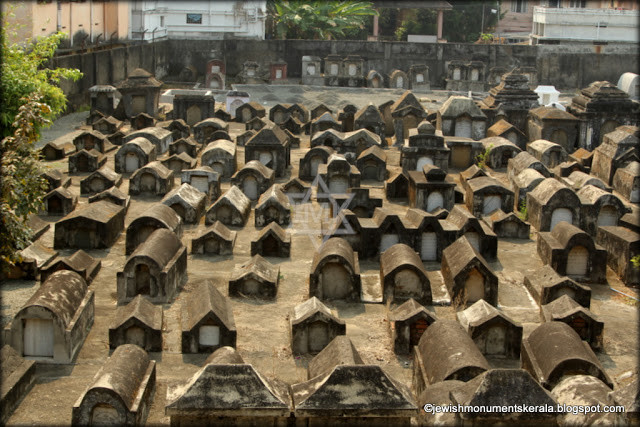
Earlier I discussed about the Paradesi Jewish cemetery (see here) and added some photographs. The cemetery is protected by a tall boundary wall enclosing all the four sides. It is unfortunately not open to visitors and the locked iron gate at the entrance near the north-east corner is the only position to observe the tombs. The cemetery is at least two centuries old and remains the sole graveyard of the Paradesi Jewish community of Kerala today. Apparently an older cemetery belonged to the community adjacent to the Paradesi Synagogue, however it stopped functioning by late 18th century and nothing remains from the site (see here). The planks installed in Hebrew, English and Malayalam languages, at the entrance of the cemetery indicate that the current compound wall was erected in 15th September 1898.
There are more than 300 tombs in the Paradesi cemetery, higher than in any other Jewish cemeteries of Kerala. Although the cemetery possesses mostly tombs of the Paradesi Jews, a section of the graveyard was separated for the so-called Meshuchrarim community. Confined to the end of western boundary wall, these tombs were segregated from the main section by a partition and a stinking pond when Rabbi Louis Rabinowitz visited the area in 1952.

The yellow dotted lines mark the area of Meshuchrarim tombs


Sunday, 25 February 2018
LEGENDS ABOUT THE 'JOOTHAKULAM' (JEW POND), METHALA-KODUNGALLUR-Local Versions
Although most of the
residents were amused to hear a Jewish connection to their small village, I was
lucky to find a few senior (aged 70 plus) members who added interesting
information about ‘Joothakulam’. What I have learnt from them were:
1) There were two hills in
the region, the Cheriyakunnu (Small Hill) and Valiyakunnu (Large Hill), the
area between them were owned completely by Jews. The Valiyakunnu was flattened
out and has lost all its hilly nature now. The Cheriyakunnu is still visible as
an elevated ridge, presently the Kunnamkulam village centre where ‘Joothakulam’
exists by the name Kunnamkulam (Hill-Pond). There was also a large pond in the
Valiyakunnu area, but it does not survive now. Valiyakunnu was in the beginning
of the road that runs south from the Kunnamkulam centre to Edamukku.
2) Long time ago there
were two Jewish brothers who owned most of the land in the region. Their large
mansions were located near Methala Upper Primary School, but all of its traces
are gone. One brother owned the large pond area and the other's share was the
smaller pond, both used by their respective family members. Names of the
brothers are vaguely remembered by a local and he spelled their names Cheriyakarnan
and Valiyakarnan. Isn’t it fanciful to relate Cheriyakarnan with Chirianandan.
Subscribe to:
Posts (Atom)